In this article, I am going to spill the beans on one of my favorite ways of finding turnaround cases: by following the breadcrumbs left by a vulture fund (distressed debt fund).
Distressed debt funds specialize in a niche that most traditional investors flee from: distressed corporate bonds and turnarounds. For alert investors, tracking these funds is like following the footprints of a predator that has already done the heavy lifting.
A Word of Caution: One needs to be careful with these ideas, since being wrong or being too early in these cases oftentimes means losing your capital permanently. You’ve been warned!
In today’s article, we’re going to discuss one specific vulture fund: Robus Capital Management. And we’ll look at two of Robus’s Swedish investments that I believe are the most interesting:
Seamless Distribution System (SDS): A (now) high-margin B2B telecom software business that has been restructured to the extreme to generate cash by laying off more than 1/3 of its workforce, saving ~60 MSEK in personnel costs relative to its ~160 MSEK revenue base. It is trading at 5.2x-7.2x on my estimated Owner’s Earnings, but a looming December 2027 debt maturity wall makes it a high-wire leverage act.
Moment Group: This is a post-mortem analysis of my broken investment thesis on Moment Group. I managed to exit unscathed due to an unexplained surge in liquidity. Nevertheless, as the company nears its March 2027 bond maturity wall, the post-refinanced entity could present a fascinating entry point for new investors.
But before going into the companies, their turnaround stories, valuations etc. - I’d like to first address why sourcing turnaround ideas this way is personally very interesting.
The Advantage of Scavenging the Scavenger
Due Diligence
For retail investors, studying where a distressed debt specialist deploys capital offers a shortcut. By the time a distressed debt fund takes a significant position in a distressed credit, the list has already been checked:
Downside Protection: They need to have done the due diligence necessary to ensure their downside is protected. They have torn apart the company’s financials and audited that the hard assets, soft assets and operating businesses are real.
Note: This initial downside protection is for the debt, not for the equity. But the logic flips when they move from the debt to the equity side.Cash Flow Runway: They ensure the company has enough operational liquidity to service the interest and survive a restructuring process when necessary. The company might become a zombie for a while - all cash flows are funneled to servicing debt, but it won’t instantly go into liquidation.
Reliable Accounting: Unlike retail investors who might fall for accounting manipulation, distressed debt funds have gone through the mess and have a true picture of the business’s baseline economics.
Operational Efficiency: They force the company to run lean, trim excess fat and focus on cash flow. If the current leadership cannot execute, they will not hesitate to replace them.
You just need to look at Robus’s philosophy to understand what I mean:
Attractive credit investments arise where in-depth analysis meets opportunity
Distressed debt funds filter out the hopeless distressed companies, leaving behind a curated list of viable businesses that are temporarily crushed under bad capital structures.
A Clear Catalyst
The core idea of following a distressed credit investor is to wait for a structural change to the company’s debt profile.
When a company is drowning in debt, all operating profit goes straight to servicing debt i.e. interest expense. When a player like Robus takes control and forces a restructuring (via covenant breach or debt maturity), they might trigger a combination of mechanisms that alter the company’s debt profile, lowering interest expense and/or increasing profitability.
Internal Restructuring: This can happen in several ways, e.g.
The company sells non-core divisions or struggling subsidiaries. The cash generated is used to pay down debt, shrinking liability and interest expense.
The company leans down by cutting operational bloat and lowering its cost base. This ensures that margins expand and cash flow generation improves.
Rights Issues: Existing shareholders (or new investors) inject fresh equity capital. This cash injection is used to pay debt and lower interest expense.
Bonds Impairment: Creditors agree (or are forced) to take a haircut - formally writing down the nominal value of the outstanding bonds or interest rate.
Debt-to-Equity Swap: Creditors convert their unpaid debt claims into brand-new equity, heavily diluting existing shareholders in the process. The company emerges completely or partially free of debt.
Regardless of the route, the outcome is a reduction in interest expense and/or an increase in profitability. The existing shareholders essentially lose permanent capital, while the new shareholders are free to harvest the upside. You need to make sure that you enter after such structural change has occurred.
Beware that these structural changes are not always good for the equity side either. For example: A crown jewel segment sold to pay debt does lower interest expense, but do the remaining segments actually have enough cash flows worthy of your investment money? You really need to do your own due diligence here.
Why the Opportunity Exists?
Despite these dramatic changes, most investors miss the boat. Why?
First, historical baggage. Because the company just emerged from distress, sentiment remains deeply negative. The stock chart looks depressing, and the history shows years of losses, dilution and near-death experiences.
Second, analytical complexity. Restructuring documents, asset divestments and pro-forma financials are complex, especially considering that the average investor refuses to read any financial report.
Have I convinced (or scared) you yet?
Did you read that you might lose your capital if you’re wrong or early?
In most cases, there are safer, easier investment ideas - so if you won’t do the work, my suggestion is to just skip these leveraged companies. I like complexity and I do welcome the challenge - even just for intellectual curiosity.
In any case, it’s always best to start with a small position, unless the turnaround has been proven sticky.
Are you still curious? Well, let’s get to it!
Disclaimer: I am not a licensed legal or financial advisor. I hold positions in SDS and Moment Group. The content provided in this article and in “The Northside” is for informational and educational purposes only and represents the personal opinions and interpretations of the author. It is not intended to be, and does not constitute, financial, investment, legal, or tax advice. Investing involves risk, mostly the risk of losing money because you listened to a stranger on the internet. Do your own due diligence.
Seamless Distribution Systems AB
Date: 2 Oct 2026 (article release date may differ)
Ticker: SDS (Nordic Growth Market)
Price: ~6.10 SEK
Market Cap: ~147.4 MSEK
Total Shares Outstanding: 24.16M
The Business
SDS builds mission-critical digital infrastructure for Tier-1 telecom operators in emerging markets, primarily in Africa, Middle East and Asia. In emerging markets, nearly all phone contracts are prepaid and require top-ups. Thus, telecom operators do not just sell network access; they manage multi-tiered physical distribution networks of wholesalers and millions of street-level kiosks. SDS’s ERS 360 and the new ERS 5 platforms act as the digital backbone for processing billions of telecom transactions and mobile money movements. This is SDS’s bread and butter, with revenue split between upfront software licenses and recurring support & maintenance contracts.
In addition, SDS also generates a small amount of revenues from:
Offering cloud-based hosting of the platform as a service (a SaaS model).
Mobile Financial Services that allow telecom operators to act as digital banks (taking a micro-percentage fee for every transaction).
Because these additional services ride on top of the already-built ERS platforms, incremental revenue drops almost straight to the bottom line.
The Leveraged History
2021–2024: To fund growth, SDS issued a 200 MSEK senior secured bond in 2021. As interest rates spiked and the legacy units continued to be unprofitable, SDS suffocated under the interest expense of the bonds. SDS was forced into a series of capital restructuring, resulting in multiple dilutions for legacy shareholders.
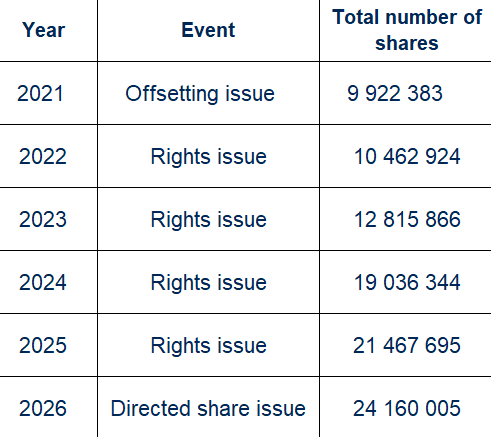
2025 – Q1 2026: In mid-2025, SDS breached the liquidity covenant (a minimum of 10 MSEK in cash) and entered a standstill agreement with the bondholders (largely controlled by Robus Capital). In February 2026, SDS executed the Leo Issue - a directed rights issue that injected 17.5 MSEK of capital at 6.50 SEK per share.
Robus anchored this equity raise, transforming from a creditor into the largest owner holding roughly 12% of the equity. Robus’s Portfolio Manager Mark Hoffmann now sits on SDS’s Nomination Committee. This 12% of equity (worth 18.8 MSEK) is potentially peanuts in comparison to Robus’s stake in SDS’s bonds. Thus, the whole thing might just be a cheap way to de-risk their loan and maintain control over the Board and management from the inside.
Today, SDS remains tethered to a ~250 MSEK in bonds bearing a fixed 9% interest rate, maturing in December 2027.
The Turnaround Thesis
The Restructuring and EBT Guidance
Management executed an extreme restructuring in 2025. They decommissioned legacy segments, accelerated customer migrations to the standard platforms and laid off roughly a third of the workforce. With these actions, management claimed an annual cost-saving of 66 MSEK in baseline operating expenses.
The workforce was reduced from 228 in FY 2024 to 162 in FY 2025, and further down to 148 by June 2026. The impact can be seen in the Q2 2026 income statement, where salary costs (“personalkostnader”) declined to 10.8 MSEK from 24.7 MSEK in the prior year. If we annualize the current run-rate, this results in 43.2 MSEK, while the salary costs for FY 2024 and 2025 were 100.0 and 107.6 MSEK, respectively. This in itself confirms ~60 MSEK in fixed cost savings.
In Q1 2026, management surprised the market by issuing guidance for 45-55 MSEK in EBT for the full year 2026, while claiming that the baseline recurring revenues now fully cover their operating expenses and the 9% cash interest expense (link).
We’ll go deeper into these numbers in the Valuations section.
Deleveraging Catalyst
Back in November 2024, when SDS released its three-year business plan (link), they explicitly set a goal to reduce the company’s debt level down from over 200 MSEK to ~100 MSEK by the end of 2027. Martin Schedin was then the CFO, with Eddy Cojulun as CEO (who now still owns 2.8% of the company). However, I would still hold Schedin accountable for this ~100 MSEK deleveraging plan, which seems mathematically impossible based on SDS’s situation today.
So, there is one thing to worry about regarding the overwhelmingly positive EBT guidance: the reliability of management’s promise. If Schedin’s EBT guidance materializes at the end of the year, he would gain credibility points back from me.
In any case, as part of the bond restructuring, the new terms introduced an early redemption mechanism, where amortization can be executed in batches of at least 10% of the outstanding bonds.
Combining these two facts together, it is very probable that a huge chunk of future cash flow would be earmarked for redeeming the bonds. Since this cash comes from operations, it practically transfers value directly from the liability to the equity side.
“Forced” Skin in the Game
The February 2026 Leo Issue was good for shareholder alignment (but obviously not so good for previous shareholders). SDS carved out CEO Martin Schedin, CFO Jens Ålander and board member Håkan Holm to participate in the directed share issue at 6.50 SEK/share. Furthermore, the units included free warrants with a 13.0 SEK strike price, maturing in February 2028. Because of this, all stakeholders are incentivized to push the share price well above 13.0 SEK within the next 18 months.
The current ownerships among the leadership:
The Chairman, Tomas Klevbo, owns 4.2% of the company (~6.6 MSEK).
The ex-Chairman, Martin Roos, owns 3.4% (~5.3 MSEK).
The other Board members own ~1.2% (~1.9 MSEK).
CEO and CFO own ~1% (~1.6 MSEK).
The New VS Ex-Chairman
Recent insider trading data reveals a leadership shift. Following his departure as Chairman, the telecom-heavy Martin Roos has dumped over 130,000 shares on the open market. However, Roos has retained his 3.4% ownership since his last sale on 22 August.
Conversely, the new Chairman, Tomas Klevbo - whose background seems to lean more toward finance and asset management - has been a net buyer from February up to this week, accumulating over 53,000 shares.
This dynamic seems to reflect the company’s evolution: the operational expert taking some of his personal stake off the table, while the financial expert builds his stake.
The Independent(?) Analyst
Adding to the intrigue is the presence of Ylber Rexhepi and Impala Nordic in the list of the Leo issue participants earlier this year (link). Rexhepi is the CEO, co-founder and Investment Manager of Impala Nordic, one of Sweden’s micro-cap equity research firms, which initiated coverage on SDS in Q1 2026. Knowing his background, this might serve as an endorsement of the new SDS’s underlying unit economics.
Valuation: Post-Restructuring Owner’s Earnings
Despite the wonderful EBT guidance, we should do our own due diligence by looking at the underlying financials. We’ll estimate SDS’s post-restructuring Owner’s Earnings. First, let’s define the recurring costs:
Interest expense: The total debt in Q2 2026 is ~270 MSEK (252.9 long-term + 17.5 short-term). To be conservative, let’s assume all of it is tied to the bonds and incurs a 9% interest, thus -24.3 MSEK annually. Since this is total liabilities, the interest part of IFRS 16 lease liabilities is already accounted for.
Capital expenditure: The actual cash investments in H1 2026 were -8.0 MSEK for intangible assets (capitalized development costs) and 0 for tangible assets. D&A (Depreciation and Amortization) was very close at -8.5 MSEK total.
FY 2025’s CapEx was 16.0 MSEK for intangible assets and 2.2 MSEK in tangible assets, while D&A was 24.4 MSEK. With write-downs of 30.4 MSEK in 2025, this results in a lower D&A in 2026.
We’ll take an annual run-rate of -18.0 MSEK for our estimation.IFRS 16 lease costs: H1 2026 states lease repayment as -0.7 MSEK. We’ll take -1.5 MSEK as an annualized conservative lease cost.
We’ll now calculate Owner’s Earnings based on two base cash flows: EBITDA and Cash Flow from Operations (CFO):
EBITDA in H1 2026 was 41.9 MSEK and evenly split between Q1 and Q2. If we take an EBITDA of 80 MSEK as our run-rate - less interest expense, less CapEx, less IFRS 16 lease repayment - the resulting pre-tax earnings are 36.2 MSEK (compare this to management’s EBT guidance of 45-55 MSEK). Deducting 21% corporate tax, the resulting net income is 28.6 MSEK.
CFO before changes in Net Working Capital (NWC) in H1 2026 was 22.2 MSEK and also about evenly split between Q1 and Q2. This number is already net of interest expense. If we take an annual run-rate of 40 MSEK - less CapEx, less lease repayment - the resulting Owner’s Earnings are 20.5 MSEK.
At the current market cap of ~147.4 MSEK, SDS is trading at an Owner’s Earnings multiple of 5.2x-7.2x.
The Risks
The Slow Payment
While SDS generated 41.9 MSEK in EBITDA and 22.2 MSEK in CFO before NWC in H1 2026, the CFO after NWC was a disappointing -1.2 MSEK. This means that changes in working capital swallowed -23.5 MSEK.
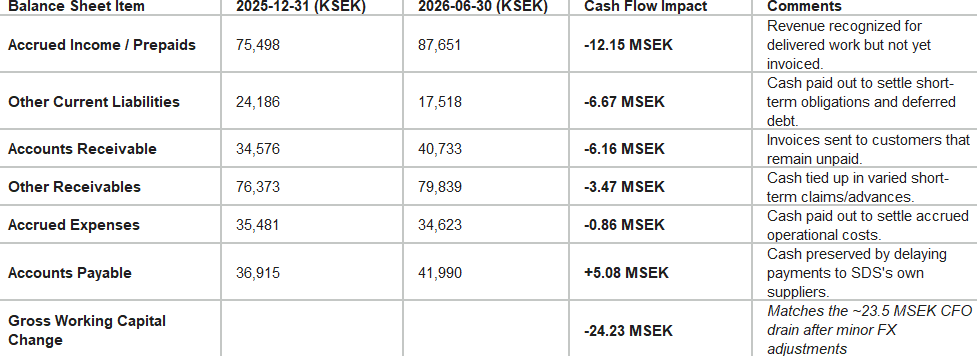
Accounts Receivable (6.16 MSEK), Accrued Income (12.15 MSEK) and Other Receivables (3.47 MSEK) represent 21.8 MSEK in cash inflows generated during H1. However, they are locked up as accounting numbers rather than hard cash in the bank. Simultaneously, management used available cash to pay down short-term liabilities (6.67 MSEK) and prepay expenses (0.86 MSEK), but stretched Accounts Payable (+5.08 MSEK). Together, this would result in ~20 MSEK theoretical net cash inflow.
This discrepancy stems directly from the slow payment cycles of their emerging markets telecom customers. Historically, SDS’s customers rarely default, meaning the cash will eventually come. However, this cash lag keeps SDS operating with a tight margin to its 10 MSEK liquidity covenant.
Emerging Market Exposure
Management likes to adjust away FX losses (16.6 MSEK in 2025), but of course currency devaluation is a real-cash problem. Nevertheless, the CFO-based Owner’s Earnings should still be valid since it accounts for FX translations. Moreover, beyond FX risks, SDS faces potential geopolitical risks as well, since the countries they operate in may have unstable political and economic environments.
A Leveraged Play!
Despite SDS’s high profitability post-restructuring, this is still a leveraged play. What would happen if they breached their covenants again? What happens when the December 2027 maturity wall is around the corner?
Let’s look at the “sweeteners” offered to bondholders during the recent 2024 Amend & Extend:
Mandatory Equity Injection: Shareholders were forced to do a 25 MSEK directed share issue.
The Liquidity: The 10 MSEK minimum monthly cash covenant was introduced.
PIK Penalty Rates: While baseline interest dropped to 9%, if management chose to capitalize (PIK) interest to save cash, the effective rate jumped to 11%. However, this option is no longer available as of 2026.
The 10% Batch Rule: A requirement that any early bond repayment must be made in 10% minimum chunks (~25 MSEK).
Assuming management can maintain current profitability and execute at least one early 25 MSEK partial redemption by Q4 2027, an Amend & Extend in 2027 is highly feasible.
However, the "sweeteners" for a 2027 extension might still be demanding. Instead of forcing shareholder dilution - which is uncalled for if SDS maintains its current profitability - bondholders will likely target the company's newfound cash flow. Potential “sweeteners“ may include forced cash sweeps (forcing a high percentage of free cash flow toward debt paydown), warrants (so bondholders can capture the post-restructuring upside) or strict partial redemption deadlines.
If you’re not into Moment Group or my post-mortem of it, you can just stop reading here.
Moment Group AB
Date: 2 Oct 2026 (article release date may differ)
Ticker: MOMENT (Nasdaq Stockholm)
Price: ~5.10 SEK
Market Cap: ~129.0 MSEK
Total Shares Outstanding: 25.3M
Let’s start with a confession: I have written up Moment Group previously as an investment idea (link), but as time went by into Q2/Q3 2026, I realized that my original thesis was broken. I was too optimistic with my analysis, misread management and the Board’s immediate intentions. I will discuss this in more depth in the Turnaround Thesis section.
Despite all that, I got lucky. In April 2026 the stock surged way above my target valuation of 200 MSEK, and I sold nearly 2/3 of my holding then. Since then, I have further liquidated my holding as new (not-so-good) information came to light. However, there’s an opportunity that the impending bond maturity in March 2027 could be the ultimate catalyst that changes their debt profile - meaning we need to be on the watch until the dust has settled.
The Business
Moment Group is an experience and entertainment company. It operates through three different segments:
Event & Communication: Helps clients communicate, strengthen and build engagement around their brands and audiences.
2Entertain: Musicals, theatre, shows and concerts. It also includes ordered (corporate) entertainment.
Wallmans Group: Includes iconic venues and restaurants e.g. Copenhagen’s Cirkusbygningen, Stockholm’s Hamburger Börs and Golden Hits.
The Leveraged History
Moment Group’s leveraged history is the story of a sound business nearly wiped out by a chain of events: starting with a debt-fueled M&A period, followed by the pandemic, capped off by punishing interest expenses.
Moment Group’s bonds were originally issued as 200 MSEK unsecured corporate bonds in March 2018. Since then, through a series of renegotiations, multiple rights issues and debt-to-equity swaps via warrants, the company has repeatedly amended the bond terms and delayed the principal repayment.
Today, the bonds have turned into senior secured debt with maturity date in March 2027. The remaining bonds amount to 109 MSEK carrying a floating interest rate of 3-month STIBOR + 6.75% - hovering around 9% at the moment. The new bond terms also grant management the flexibility to voluntarily redeem up to 50 MSEK of the outstanding bonds prior to maturity.
The Turnaround Thesis
My original thesis was based on two catalysts: deleveraging and macro tailwinds, plus the new ownership being a supporting pillar. While my initial timeline was wrong, the underlying thesis may still be valid for the post-restructuring entity after the March 2027 maturity date is resolved.
Deleveraging Catalyst
Late last year, Moment Group sold its stake in the ticketing platform Tickster for 62.5 MSEK. Because the amended bond terms allow for a voluntary 50 MSEK partial redemption, my initial thesis anticipated this cash would be earmarked to pay down part of the bonds. Instead, the cash proceeds were utilized to pay off deferred pandemic taxes and to cover operational costs.
While paying down the pandemic taxes was a good thing, I was too optimistic in thinking that some of the Tickster proceeds would be used for a partial redemption of the bonds. My initial thesis was that a 50 MSEK partial redemption would increase base cash flow after tax by 3.5 MSEK (50 MSEK x 9% interest rate x [1 - 21% corporate tax]).
Macro Catalysts
On the regulatory front, I viewed two policy changes as structural tailwinds:
Reduced employer contributions for employees aged 19-23 (effective April 2026): Assuming 25% FTEs fall into this age range, I estimated that Moment Group would be able to save about 4 MSEK in personnel costs after tax. Management explicitly mentioned that some reduction in personnel costs has been realized (due to restructuring, not the regulation) - limited to 6 MSEK. However, the financial reports do not demonstrate this, with Q2 2026 salary costs actually coming in 5 MSEK higher than in Q2 2025.
The abolition of the Swedish dance tax (effective July 2026): I estimated this would positively add ~3.5 MSEK to their base cash flow, or about ~2.8 MSEK after tax.
Gelba Management: Per Taube and Leif West
Gelba Management AB - an investment vehicle linked to Arlandastad’s Per Taube, chaired by Leif West - acquired over 1 million shares directly from Robus Capital. This transaction consolidated Gelba’s position as the largest shareholder, controlling 26.5% of the company, while Robus retained 25.2%.
Leif West became the Chairman of the Board. He has a track record of navigating distressed bond negotiations, most notably as the chair of HL18 Property Portfolio AB in late 2024. In that scenario, Gelba took over the company following a bond foreclosure and pushed through an issue of super senior priority instruments that saved the company, but wiped out legacy shareholders in the process.
The initial idea was that with the backing of Gelba’s capital and a partial redemption from the Tickster sale proceeds, Moment Group would be able to achieve an advantageous Amend & Extend or execute a bank refinancing.
Valuation: Owner’s Earnings
As with SDS, we’ll value Moment Group by estimating its Owner’s Earnings from the cash flow statements.

As a live entertainment company, Moment Group’s working capital swings are dominated by prepaid ticket sales (recorded as prepaid ticket revenue in the liability side of the balance sheet). Because they collect cash from customers months before performing a show, using CFO after working capital creates distortions. To correct for Moment Group’s negative working capital model, we’ll use CFO before NWC as our baseline.
Here is the Owner’s Earnings bridge derived from their financials:
Base Cash Flow: Moment generates the bulk of its revenue in Q3 and Q4, making H1 figures seasonally negative. For this reason, we’ll ignore the H1 2026 numbers.
Furthermore, 2021 figures were inflated by COVID subsidies, while 2022-2023 benefited from a post-pandemic demand whiplash. Normalizing for these distorted years, we will assume a mid-cycle baseline cash flow of 60 MSEK.CapEx: Last year, CapEx increased due to renovations at Cirkusbygningen. Accounting for this, we’ll assume a normalized maintenance CapEx of -15 MSEK.
IFRS 16 Lease Cost: Venue leases are Moment Group’s mandatory operating costs - we’ll take -40 MSEK as the annualized lease repayment cost.
Using the numbers above, we estimate the implied normalized Owner’s Earnings as 5 MSEK. If we take the 2025 CFO before NWC of ~44 MSEK, the Owner’s Earnings falls deep into negative territory.
Despite the headline adjusted EBIT of 28 MSEK in 2025, the normalized Owner’s Earnings is almost non-existent at 5 MSEK. What causes the discrepancy? EBIT does not reflect the ~40 MSEK in cash principal lease repayments fairly, while total interest expense itself is already draining 35-40 MSEK in cash.
So, where did I go wrong?
Accounting for an additional ~10 MSEK in net cash savings I originally projected from the turnaround catalysts, my previous model estimated Owner’s Earnings at over 15 MSEK. Using a 10x multiple, this amounts to ~150 MSEK in implied Equity Value. Additionally, at the time of my analysis, I expected Moment Group to reach a net cash position (excluding lease liabilities) by year-end 2025, buoyed by the 62.5 MSEK Tickster sale proceeds. They actually did have a net cash position of 41 MSEK at the end of 2025, but that doesn’t matter now.
My assumptions proved to be too optimistic. No partial bond redemption. No clear signs of reduction in salary costs. With the looming 109 MSEK bond maturity less than six months away, it becomes evident that Moment Group might not be able to service its debt, making a dilutive restructuring or capital raise highly likely to smooth out the Amend & Extend agreement with bondholders.
The Opportunity and Risks
Given that Gelba is backed by Per Taube - a billionaire real estate magnate with deep pockets - there is a viable path to a stabilized debt profile. The opportunity hinges on Gelba’s financial muscle to back the upcoming March 2027 refinancing. Whether this results in a negotiated Amend & Extend or in securing a cheaper loan, this won’t happen for free and some “sweeteners“ will be necessary.
The “sweeteners“ would most probably be extracted from the equity layer, taking the form of a partial upfront cash paydown, debt-to-equity swap or an equity kicker - resulting in dilution for existing retail shareholders. However, for new incoming shareholders, the post-refinanced entity may present an attractive entry point.
Despite the opportunity for financial stabilization, some risks remain:
Macro factors: Moment Group is exposed to the discretionary consumer cycle.
Insider factors: So far the insider holdings leave much to be desired, especially from the CEO. In addition, the recently announced departure of CFO David Mårtensson just six months before the maturity wall is also a worrying sign.
Still a leveraged play: Ultimately, with a 129.0 MSEK market cap paired with 109 MSEK in bonds and very low Owner’s Earnings, Moment Group is still very much a leverage play. Its debt profile needs to be drastically changed in order to make it safe for retail investors to join in for the equity upside.
“Return of Capital is more Important than Return on Capital” - I still love this! (taken from CrossingBridge Advisors’ philosophy).